
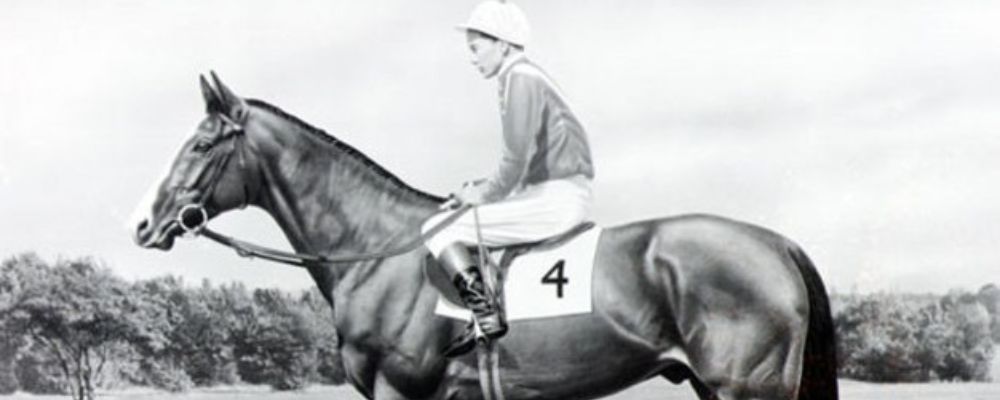
At the end of this week Newbury racecourse will stage one of the most important early season National hunt races, the Coral Cup. The famous race, first run in 1959 at Cheltenham (it moved to the Berkshire course in 1960) as the Hennessy Gold Cup has been won by many of the chasing greats. Former Cheltenham Gold Cup winners Arkle, Denman, Mandarin, Mill House, and Grand National winner Many Clouds have all triumphed in the three mile two-furlong contest.
However, in 1968 Aurelius, a classic winner, a two-time victor at Royal Ascot, who ran in the Arc and who later finished 2nd in the Champion Hurdle in 1967 before being disqualified, lined up in the 11 runner field.
One of his significant claims to fame was winning at Ascot on the flat, hurdles and over the jumps, a course which for many years commemorated this achievement by hosting a juvenile hurdle race in his name.
This comprehensive blog by Stephen Wallis of The Paddock and The Pavilion tells the story of Aurelius, a unique horse.
background
Aurelius was foaled in 1958 and bred at the Tally Ho stud in Ireland. His sire was the Queen Elizabeth II owned Aureole, flat horse of the year in 1954, when he won the King George VI and Queen Elizabeth Stakes at Ascot after finishing 2nd in the previous year’s Epsom Derby. Aureole’s other successful progeny included St Paddy (1960 Derby and St Leger winner) and Saint Crispin III (1959 Prix de L’Arc de Triomphe winner), which made him the champion sire in 1960 and 1961. Aurelius’s dam was Niobe an American bred mare, whose dam was a full sister to 1944 Oaks winner Hycilla.
Noel Murless purchased the big bay horse with a broad white blaze and three white socks as a yearling at the autumn sales for £5,000 as he liked him, although he had no one to buy him for. However, as Murless recollected in his biography “The Guv’nor” when he got home from the sales, he received a phone call from his old friend Tom Lilley and asked him if he wanted the horse. Tom agreed, although sadly, he had died before Aurelius won the St Leger. The horse ran in the scarlet colours with white V and cap of Tom’s wife Vera, later Mrs Hue Williams.
two year old career
As a backward two year old the colt only had the one run in 1960 when he ran a decent 4th in the Royal Lodge Stakes over 1 mile at Newbury on 23 September with Warren Place’s stable jockey, Lester Piggott on board. The race usually run at Ascot was moved to the Berkshire course owing to a new grandstand being built at the regular venue.
three year old career
Noel Murless’s 1961 campaign was dominated by the saga of Pinturischio. Whilst that colt was grabbing the headlines with his impressive success in the Wood Ditton Stakes and a close 4th in the 2,000 Guineas, his inferior stable companion began his classic season on 11 April in the Craven Stakes. Emerging victorious by two lengths at 8/1 Aurelius bypassed the 2,000 Guineas and instead ran in the Newmarket Stakes (1m 2f)) where he finished 2nd.
Pinturischio was Warren Place’s first choice for the Derby, and he was made the ante post favourite. However, the colt was infamously nobbled twice by a doping gang and as a result on 27 May Pinturischio was scratched from the premier classic due on 31 May. Aurelius, now Murless’ principal Derby hope, himself was withdrawn on the eve of the race due to the firm going.
Aurelius headed to the Royal meeting where with better ground he triumphed in the King Edward VII Stakes. An excellent trial for the St Leger followed in the Great Votigeur at York’s August meeting, where he finished 2nd.
st leger victory
The final classic on 9 September provided Aurelius the opportunity to show his forte, stamina.
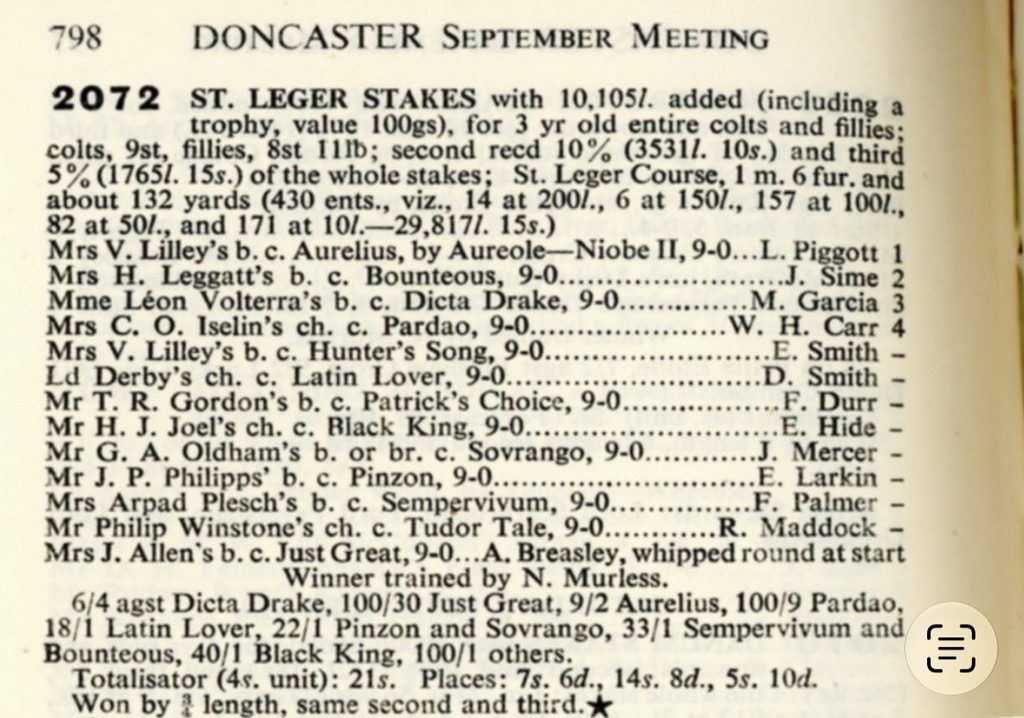
To assist his galloping style Mrs Lilley also entered Hunter’s Song as a lead horse for Aurelius and the colt immediately hit the front. Hunter’s Song went into a substantial lead and set the pace for the first mile but was done by the turn.
His regular partner Lester Piggott gave him a master class of a ride. Always going well, third entering the home straight he waited until the final furlong to pass the French trained favourite Dicta Drake, the Derby runner up and kept on strongly to hold off Bounteous to win by three quarters of a length. Dicta Drake finished 3rd. In 1962 Dicta Drake won the Coronation Cup at Epsom.
four year old career
In May 1962 Aurelius began his season by winning the Coombe Stakes at Sandown in preparation for another crack at his favourite course Ascot and the Royal meeting. This time he captured the Hardwicke Stakes at 8/13 in a four runner field with champion jockey Scobie Breasley in the saddle.
It was Ascot where he recorded best ever performance when on 21 July, he contested the prestigious King George VI and Queen Elizabeth Stakes. Again, ridden by Breasley he finished 2nd in the mile and half contest, three quarters of a length behind French raider Match III.
The star studded field had included the 1962 French Derby winner, Val du Loir along with Dicta Drake, Arctic Storm (2nd in 1962 Irish Derby) and West Side Story (2nd in 1962 Oaks).
After justifying his 1/4 odds in September’s Atalanta Stakes at Sandown the four year old was ready for a tilt at the European season’s finale, the Prix De de L’Arc de Triomphe.
French horses Match III, Val Du Loir and Monade (1962 Oaks winner) lined up at Longchamp though a 40/1 fellow Gallic horse Soltikoff triumphed with Aurelius (13/2) a distant 15th of 24 runners. The colt had been well enough placed shortly before the turn but as Piggott remarked later, when the field reached the straight “they really turned on the pace and he simply could not go with them”
a failure at stud
Mrs Lilley then syndicated the colt to stud with thirty shares at £4,000 each. That was expected to be the last the general racing public saw of the galloping, but temperamental classic winner, who Murless described as a bad worker at home, but on the racecourse you could do anything you liked with him. Clive Brittain, who at that time rode him out at Warren Place, where he worked for twenty three years described the colt as savage with a capital S in his biography “The Smiling Pioneer.” The rogue needed the lead horse at least 30 yards in front of him as he had instances of attacking the horse in front.
His stud record was disastrous as he covered 13 mares but failed to get any of them into foal. As a result of this fiasco Aurelius was gelded and returned to the track on the 22 April 1964 in the Ballymoss Stakes at the Curragh. Now trained by Paddy Prendergast in Ireland he started joint favourite and ran very well to finish 3rd.
a national hunt campaign
In 1965 he moved to Ken Cundell’s mixed yard at Roden House stables at Compton in Berkshire. His debut under Cundell’s tutelage came in November when he ran on the flat at Lingfield Park where he finished 9th of 12 runners in preparation for a National Hunt campaign as a novice hurdler.
He made his hurdling debut at Sandown Park on 6 November 1965 in the Black Hills Hurdle over 2 miles, a date etched in National Hunt history when on the same card the mighty Arkle defeated Mill House by 20 lengths conceding 16lbs and breaking the course record by 17 seconds. He finished only 4th of 8 runners but soon followed up with successive wins at Ascot and Kempton with Bill Rees on board.
off to the cheltenham festival
Aurelius’s next landmark was to run at the Cheltenham Festival where he finished 2nd (beaten 12 lengths) in a Division of Gloucestershire Hurdle now known as the Supreme Novices Hurdle, the same day the legendary Flyingbolt won the Champion Chase by 15 lengths. He completed his first season over the sticks with an impressive win in a handicap hurdle at Cheltenham, carrying top weight, 11st 11lb’s under his new regular jockey Des Briscoe. Briscoe had ridden him in on his first outing over hurdles and at the recent festival meeting.
The gelding then returned to the flat at Alexandra Park where with Walter Swinburn senior on board he won over 1m 5 furlongs. Subsequently, after a defeat at Brighton he ran second in a thrilling finish to the Henry II Stakes at Sandown Park over 2 miles. With Aussie Scobie Breasley back as jockey he was beaten only by half a length by Fighting Charlie, the 1965 Ascot Gold Cup winner, who proceeded to capture the distinguished prize again at the following month’s Royal meeting.
a champion hurdle campaign
The eight year old had run his last race on the flat and Cundell began to plan a Champion Hurdle campaign. However, he then had a period of ten months off the course after straining a tendon and Ken Cundell reported that training the gelding had become a day to day affair. He returned in the Kingwell Hurdle at Wincanton where he was placed 3rd.
On the back of this performance, a week later he went off as the 7/1 favourite for the valuable Schweppes Gold Trophy handicap (now known as the William Hill Hurdle) at Newbury carrying 11st 6lbs but finished only 9th in the 28 runner field.
Without doubt Aurelius’s best performance over hurdles came in his next race the 1967 Champion Hurdle where he crossed the line second, beaten 4 lengths at 18/1 by Saucy Kit. However, hanging left in the home straight he bored into the Queen Mother’s horse Makaldar, the 11/4 favourite and consequently the eccentric former classic winner was inevitably disqualified and placed last in the 23 runner field.
the final adventure – steeplechasing
Three time champion jockey Stan Mellor was his usual partner in the 1967/68 campaign and after two runs over the small obstacles Cundell took him on his final adventure, steeplechasing. After an impressive 2nd on his debut in the Express Steeplechase at Sandown Park (January 1968) he proceeded to win his next two chases at Ascot (Grange Chase) and at Sandown Park (Scilly Isles Beginners Chase) in February both over 2 miles. His old eccentricities remained though, as after his first run over fences he had run out when an odds on favourite in a hurdle race at Windsor and then refused in his final race of the season at Kempton when a short priced favourite.
In what was to be Aurelius’s final season (1968/69) he began in a couple of quality hurdle races at Newbury and Sandown, which featured Saucy Kit and Salmon Spray (1966 Champion Hurdle winner), but finished down the field on both occasions with Terry Biddlecombe in the saddle. His penultimate race of his career came at Ascot in the Black and White Whisky Gold Cup Chase (November 23rd, 1968) where he refused. On the same day, a juvenile hurdle was run at the course bearing his name, to commemorate his amazing achievement of winning races at the course in all three racing disciplines.
the hennessy gold cup
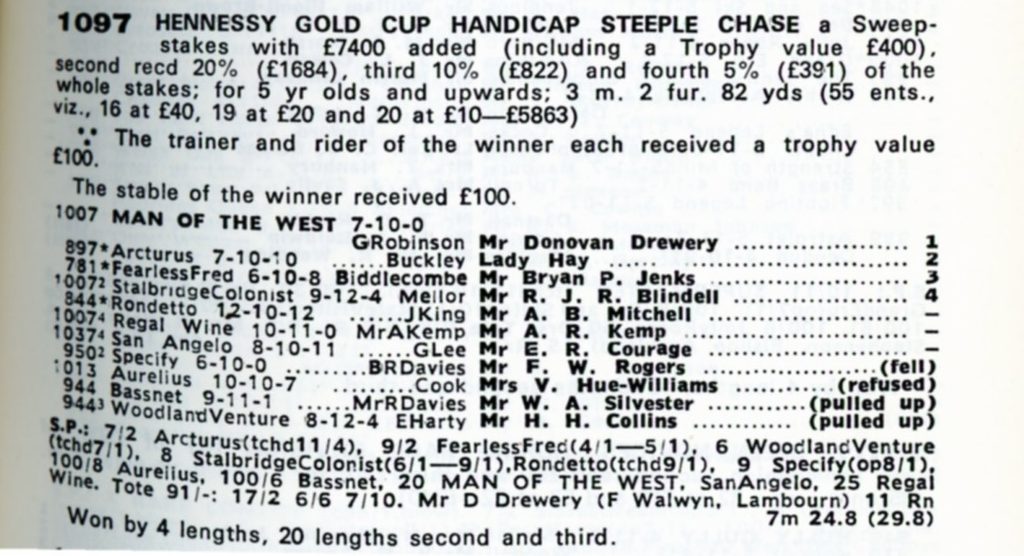
The gelding’s final appearance saw him return to where it all began, Newbury, on Saturday 30 November in the prestigious Hennessy Gold Cup. The quality field of 11 featured Ken Cundell’s top chaser, Stalbridge Colonist, famous for beating Arkle in the same race in 1966, Rondetto who won the race in 1967, Woodland Venture (1967 Cheltenham Gold Cup winner) and future Grand National winner Specify (1971). However, the near 11 year old carrying 10st 7lb’s with John Cook in the saddle bowed out in typical fashion refusing at the 12th. The race was won by Fulke Walwyn’s Man of the West with Stalbridge Colonist only 4th.
a remarkable career
Aurelius had enjoyed a remarkable career which due to his total failure as stallion encompassed such diverse occasions as Royal Ascot, the Arc, and the Cheltenham festival. He finished with seven wins on the flat, three over hurdles and two over the largest obstacles.
Whilst he could never be regarded as great horse, he was an excellent galloper, who preferred a cut in the ground and mixed with the best mile and a half horses of his age. Perhaps, he would have made an ideal cup horse, but that course wasn’t taken.
However, his failings at stud allowed him the chance to undertake an interesting National Hunt career. But unquestionably his Achilles heel was his temperament, which dogged his latter career.
There really was only one Aurelius, a unique horse.